
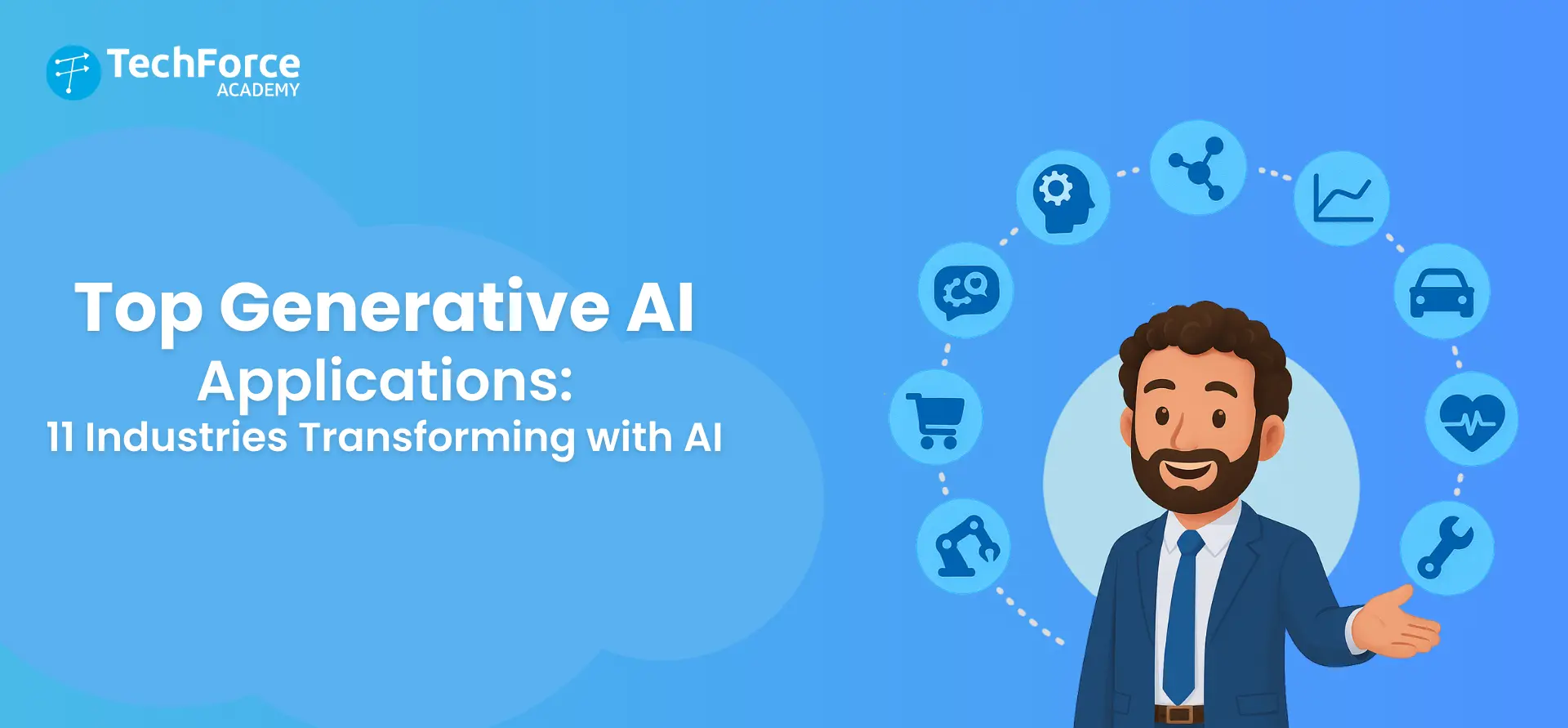
Generative AI is an emerging technology with huge potential. As predicted by Gartner, generative AI will be used by more than 100 million individuals by 2026. According to a McKinsey study, the adoption of all 63 generative AI use cases may boost the global economy by an estimated $2.6 trillion to $4.4 trillion.
In this blog, we will explore the top 11 industries using the applications of generative AI in 2026 with real-world examples.

1. Generative AI in Healthcare
Personalised Treatment Plans
To develop highly customised treatment plans, generative AI can analyse a large quantity of patient data, like genetic test results and medical imaging.
Drug Discovery
Using a method known as generative design, researchers can apply generative AI to research and develop new medicines.
Medical Imaging
Generative AI can improve medical images like X-rays and MRIs by synthesising or reconstructing them. It can also create reports about these images and even generate new images to show how a disease might progress over time.
Synthetic Data Creation
Generative AI tools like those from Insilico Medicine can create synthetic patient data. This is useful for training machine learning models while protecting patient privacy.
Early Disease Detection
Apps like SkinVision analyse skin images using generative AI to find early indicators of conditions like skin cancer and help with diagnosis.
2. Generative AI in Financial Services
Investment Strategy Creation
Generative AI can recommend and execute investments that align with your or your client’s financial goals. It can find and make trades much faster than a person can, all while staying within your set parameters.
Fraud Detection
American Express uses generative AI to analyse credit card spending patterns and detect fraudulent activity before it occurs.
Risk Analysis
JPMorgan Chase uses generative AI to assess risk for loans and investments. This allows them to identify potential issues before they happen.
Documentation and Regulatory Monitoring
Generative AI can keep you updated on regulatory changes and quickly draft documents like investment research reports or insurance policies.
3. Generative AI in Advertising and Marketing
Marketing Content Generation
Marketing teams may use generative AI to produce branded, consistent content and graphics for their campaigns. Businesses can readily enter new markets due to its ability to translate material.
Personalised Recommendations
Generative AI can power personalised recommendation engines, making it easier for customers to discover products they might like. This technology can also make the recommendation process more interactive.
Product Description Creation
Beyond high-level marketing, generative AI can handle more tedious content tasks, such as creating product descriptions.
SEO Enhancement
Generative AI is a tool that SEO experts can use to create text drafts, page titles, and image tags. Gemini and ChatGPT are the tools that can be used to recommend methods to improve content for higher search engine rankings.
4. Generative AI in Manufacturing
Faster Design Processes
Generative AI can accelerate the design process by quickly generating and evaluating design ideas based on project requirements. This allows engineers and project managers to work much more efficiently.
Smart Maintenance Solutions
Generative AI can help maintenance professionals track equipment performance. For this, it can use historical data to predict potential malfunctions before they happen. The technology can also recommend routine maintenance schedules.
Enhanced Supply Chains
You can use generative AI to identify the root cause of supply chain issues. By conversing with the AI, you can sort through vast amounts of data to find problems. The technology can also generate delivery schedules and recommend suppliers.
5. Generative AI in Software Development
Code Generation
Generative AI can help software developers by creating, optimising, and auto-completing code. By comparing new code to a vast library of existing information, it can generate entire code blocks. It can also predict the rest of the code a developer is typing, similar to how auto-complete works on a smartphone.
Much of this progress comes from large language models (LLMs) that power these coding tools
Programming Language Translation
Developers can use generative AI to interact with software without needing to know a specific programming language. In this case, the AI acts as a translator.
Automated Testing
Generative AI can enhance automated testing by quickly identifying potential problems and running test sequences. It can learn the software’s logic and user behavior to create test cases that simulate various user scenarios.
6. Generative AI in Media and Entertainment
Content Creation
Generative AI can create new video content from scratch. It can speed up the video editing process by adding visual effects and graphics.
Sports and Event Highlights
For live events and sports, generative AI can instantly create highlight reels. It can also allow fans to create their own custom highlights like a reel of a specific play or a tournament series.
Graphic Design
Canva uses AI features to simplify graphic design. Users can easily create high-quality visuals, automatically resize images, and even generate designs from text. This makes professional-looking content accessible to everyone.
Content Management and Tagging
Generative AI can automatically tag and index large media libraries, making it easier to find specific files. You can use conversational language to search for the media you need, even within a complex library.
7. Generative AI in Cybersecurity
Anomaly Detection
Generative AI is capable of analysing large data sets and determining typical network behavior. As a result, it can detect unusual activity, like a sudden rise in traffic, which may indicate malware or unauthorised access.
Phishing Detection
Using natural language processing (NLP), generative AI can analyse the content of emails and social media messages. This helps to detect subtle signs of phishing attempts, helping to counter advanced attacks.
Incident Analysis and Prioritisation
Generative AI can automatically analyse security incidents in real time and prioritise them by severity. This allows security teams to respond to the most critical threats first.
8. Generative AI in Education
Mathematics
Students can learn fractions by following a recipe. They will discover the practical applications of fractions as they measure ingredients.
Science
A neighboring lake or river’s water quality might be tested by students in an environmental science class. They will have a better understanding of pollution and its impacts on the local ecosystems through this practical exercise.
Literature
Students should be encouraged to read and discuss contemporary texts that address current social problems. They can relate concepts from literature to actual circumstances as a result.
Generative AI is also opening doors for skill development and upskilling in education.
9. Generative AI in Gaming
Pokémon Go
In this well-known mobile game, virtual Pokémon characters are positioned in actual places. To locate and “catch” them, players must physically explore their surroundings, which promotes more outside activity..
Duolingo
Duolingo makes learning a new language more fun and engaging. It incorporates game-like features such as badges, levels, and leaderboards to motivate users and make the process more enjoyable.
Fitbit
The Fitbit app turns fitness into a game. Users can set goals, track their activity, and compete in challenges with friends. This promotes a healthier lifestyle through friendly competition.
10. Generative AI in Virtual Assistants
Erica (Bank of America)
Erica is a virtual financial assistant that helps over 25 million people manage their accounts, pay bills, and analyse their spending. The tool makes banking more accessible and efficient for users.
Amazon Alexa
Alexa gives personalised product recommendations to customers by analysing their preferences and past purchases. This makes the shopping experience easier.
Duolingo’s AI Tutor
Duolingo uses an AI tutor to customise language lessons based on a user’s progress. It gives real-time feedback and a gamified learning experience to make language learning more engaging.
Want hands-on practice? Explore our Generative AI LLM course to see how conversational AI is built.
11. Generative AI in Content Creation
Netflix
Netflix uses AI to analyse viewing habits and preferences, offering personalised recommendations that significantly increase user engagement. In fact, these recommendations are responsible for 80% of the content streamed on the platform.
Sephora
Sephora’s “Virtual Artist” is an augmented reality app that lets users virtually try on makeup. This feature improves the shopping experience by allowing customers to interact with products in a personal way.
StoryChief
StoryChief is an AI system that helps writers create blog articles. It can generate headings and SEO metadata, which helps writers overcome writer’s block and save time in the content creation process.
For professionals, understanding the importance of generative AI certification can provide an edge in this rapidly evolving space.
Conclusion: Generative AI Is a Business Imperative
Generative AI applications are no longer experimental—they are transforming healthcare, finance, education, manufacturing, entertainment, and beyond.
The key takeaway? Generative AI isn’t replacing humans—it’s amplifying human creativity and efficiency. Organisations that adopt this technology responsibly, balancing productivity with ethical AI practices, will gain a sustainable competitive edge in 2025 and beyond.
If you’re ready to build practical expertise, check out our 8-week course on Generative AI.







 Google